
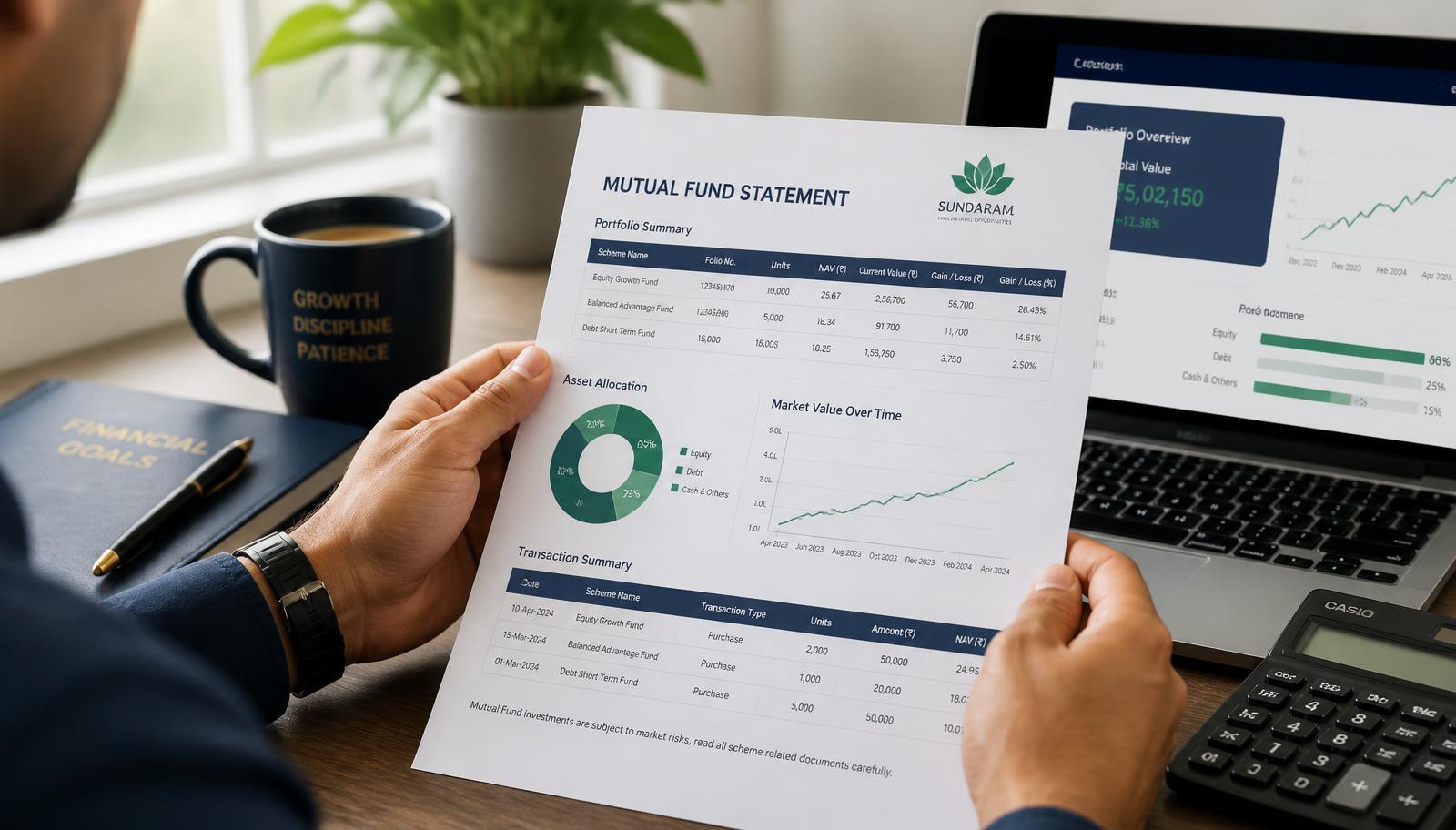
A simple, complete explanation of mutual funds in India: how your money is pooled and managed, the types of schemes, NAV, costs, risks and how to pick the right one.
A mutual fund is a pool of money. Thousands of investors contribute to that pool, a professional fund manager invests it in shares, bonds or a mix of both, and every investor owns a proportionate share of the portfolio. You do not need lakhs of rupees or market expertise to start. You can begin with a few hundred rupees a month and still own a slice of a diversified portfolio.
How the money actually moves
- You invest in a scheme run by an asset management company, which is registered with SEBI.
- Your money is added to the scheme's corpus and you are allotted units at the current NAV.
- The fund manager buys securities that match the scheme's stated objective.
- As those securities gain or lose value, the NAV of your units moves with them.
- When you redeem, your units are sold back to the fund at the NAV of that day and the money reaches your bank account.
What NAV really means
NAV is the net asset value of one unit. It is the total value of everything the scheme holds, minus expenses, divided by the number of units outstanding. A scheme with a NAV of 15 is not cheaper than one with a NAV of 400. What matters is the percentage return, not the price of a unit.
The main types of mutual funds
- Equity funds invest mainly in shares. Highest long term growth potential, highest short term swings. Suitable for goals five years away or more.
- Debt funds invest in government securities, treasury bills and corporate bonds. Steadier, used for short and medium term needs and for parking surplus cash.
- Hybrid funds mix equity and debt in a fixed or flexible ratio. A comfortable middle path for first time investors.
- Index funds and ETFs simply copy an index such as the Nifty 50. Low cost, no fund manager bets.
- Solution oriented funds are built for a specific purpose such as retirement or a child's education, usually with a lock in.
Within equity there are further categories defined by SEBI: large cap, mid cap, small cap, flexi cap, focused, value, sectoral and thematic. Each carries a different level of risk, and the category matters far more than last year's star rating.
What it costs you
Every scheme charges a total expense ratio, quoted as a percentage of assets per year. It is already adjusted in the NAV, so you never pay it separately. Index funds usually charge the least, actively managed equity funds the most. There is no entry load in India. Some schemes charge a small exit load if you redeem within a defined period, often a year.
Direct plans have a lower expense ratio because they exclude distributor commission. Regular plans include advice and service. The right choice depends on whether you want to manage allocation, rebalancing and tax on your own.
The risks nobody should hide from you
Mutual fund returns are not guaranteed. Equity schemes can fall 30 per cent or more in a bad year. Debt schemes carry interest rate risk and credit risk. The real risk for most investors is behavioural: stopping an investment after a fall, or chasing a fund only because it topped last year's chart.
How to choose a scheme sensibly
- Start from the goal and the time you have, not from the fund.
- Fix the asset allocation between equity and debt first.
- Pick a category that matches that allocation.
- Inside the category, look at long term rolling returns, consistency, downside protection, fund manager tenure and expense ratio.
- Keep the portfolio small enough to track. Four to six schemes is usually plenty.
Taxation in one line
Equity oriented schemes are taxed at 20 per cent on gains booked within a year and 12.5 per cent on gains after a year, with the first 1.25 lakh of long term gains exempt in a financial year. Non equity schemes are taxed at your slab rate. The detail matters, so plan redemptions with your advisor.
The takeaway
A mutual fund is not a single product. It is a container that can be filled with almost any kind of asset. Used with a plan, the right mix of schemes becomes the simplest wealth building engine available to an Indian household. Used without a plan, it just becomes another folio gathering dust.
Want this applied to your own portfolio?
Our advisors will review your holdings, goals and tax position, and give you a clear plan. No obligation.
Book a free portfolio review